View or edit on GitHub
This page is synchronized from trase/data/brazil/logistics/silos/silo_map_v3/qa/pii_analysis.md. Last modified on 2026-09-20 13:50 CEST by Nicolas Martin.
Please view or edit the original file there; changes should be reflected here after a midnight build (CET time),
or manually triggering it with a GitHub action (link).
PII in the Brazil logistics silo map (v2)
- Motivation
- Analysis
- Overview
- 1. Tax ID: CPF vs CNPJ
- 2. Fuzzy detection of personal names
- Sanity check: how good is the heuristic?
- 3. Potential PII rows by source
- 4. What’s left after removing
nameandcnpj? - Caveats
Motivation
This investigation was prompted by concerns raised during Open Supply
Hub’s review of the Brazil soy facilities dataset ahead of Spotlight
onboarding. A substantial number of values in the company_name field
appeared to be the names of individuals rather than registered
businesses, creating a potential risk of publishing personally
identifiable information (PII), particularly where facilities may
represent sole traders or individual farmers. Because the dataset was
identified using machine-learning methods and enriched with information
from Google Places and Gemini, it was necessary to assess how frequently
personal names occur and whether additional filtering or masking is
required. The analysis must also account for Open Supply Hub’s matching
requirements: facility names need to remain verifiable and
distinguishable, so generic placeholders or identical replacement names
cannot be used across multiple records.
Analysis
This analysis is based on
s3://trase-storage/brazil/logistics/silos/silo_map_v3/silos_consolidated_brazil_2025_1.geojson.
Overview
13270 rows in total, across 4 data sources. Columns present in the raw file: idx, trase_id, trase_state_id, category, cda, cnpj, company_name, cnae, cnae_name, cnae_secondary, start_activity_date, municipality, full_address, latitude, longitude, storage_capacity, source, source_metadata, processing_capacity_tonnes_day, capacity_source, source_label.
1. Tax ID: CPF vs CNPJ
A Brazilian CPF (Cadastro de Pessoas Físicas, 11 digits) identifies
an individual; a CNPJ (Cadastro Nacional da Pessoa Jurídica, 14
digits) identifies a legal entity (company, cooperative, or a
registered rural producer). Where the cnpj field is populated we check
digit count and official check-digit validity with stdnum.br.cpf /
stdnum.br.cnpj (the house standard used elsewhere in this repo, e.g.
trase/data/brazil/beef/sei_pcs/v2_2_1/brazil_beef_exporters_enriched.py).
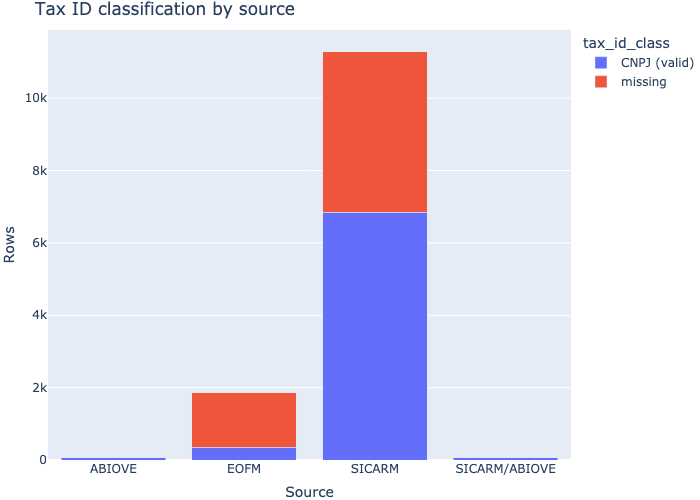
Finding: SICARM is the striking one — a large share of SICARM rows
(0 of 11,290, about 0%) carry a CPF rather than a CNPJ — these are
individual rural producers registered by their own tax ID, with their
full personal name in the name column. The CNPJ (RFB) extract, by
construction (it’s pulled from the CNAE 0163600 grain storage registry),
is 100% CNPJ. Google Maps rows mostly have no tax ID at all (they’re a
places scrape), though a minority were back-filled with a CNPJ by the
merge step in 4. silos_v2_types.R.
2. Fuzzy detection of personal names
Tax ID alone under-counts individuals for two reasons: (a) Google Maps
never carries a CPF, and (b) even where SICARM assigns a CNPJ, the
registrant name is sometimes still visibly a person (e.g. a family-run
operation registered under an individual-style CNPJ rather than a
company name). So we add a name-based heuristic, using rapidfuzz fuzzy
string matching against a curated list of ~250 common Brazilian first
names, combined with regex exclusion of legal-entity and
facility-descriptor vocabulary (LTDA, S/A, COOPERATIVA, SILO,
FAZENDA, …). Two tiers:
is_bare_personal_name— the entire name field is just a person’s name (2-4 tokens, no company/facility words, first token fuzzy-matches a known first name). This is the signal that matters for SICARM/RFB, wherenameis the registrant name.mentions_personal_name— a looser signal: any token in the name fuzzy-matches a known first name, even alongside facility words. This catches Google Maps listings literally named after their owner (e.g."Silo Eduardo Tannous"), while excluding saint/place names (São José,Santa Terezinha) which are toponyms, not identifiers of a living person.
Sanity check: how good is the heuristic?
SICARM’s CPF flag gives us rare ground truth to check the heuristic against — rows with a CPF are individuals, rows with a valid CNPJ mostly are not.
Recall is ~60% (regional/foreign-origin first names not in the reference
list are missed — this is a lightweight heuristic, not a trained NER
model) and the false-positive rate is low (~1%). Interestingly, most of
those “false positives” — SICARM rows with a valid CNPJ where the name
still reads as a person (e.g. PEDRO JOSE DILLY,
MARIA ALBINA POSSEBEN) — are genuinely personal names; several even
carry the Brazilian cadastral suffix E OUTRO(S) (“and other(s)”),
indicating joint individual ownership registered under a CNPJ. So the
heuristic is arguably finding real PII that the tax-ID check alone would
miss, not making an error.
3. Potential PII rows by source
A row is flagged as potential PII if it has a CPF, or the name field
is a bare personal name (tiers combined = “this row identifies a
specific individual”). mentions_personal_name is reported separately
since it’s a softer signal (a facility named after someone, most
relevant for Google Maps, which never carries a CPF).
SICARM dominates both in absolute count and in share — it’s the source
that registers individual rural producers directly. The CNPJ/RFB extract
is close to zero by construction (filtered to a company registry).
Google Maps has no potential_pii rows under the strict definition (no
CPF, and listing names always include a facility word so never trip the
bare-name tier) — but a non-trivial number of its listings still
mention an identifiable person’s name (see mentions_personal_name
above), e.g. "Silo Eduardo Tannous", "Silo Maria Cândida",
"AGRO DGM - Décio Gomes".
4. What’s left after removing name and cnpj?
Caveats
- The name heuristic is a lightweight regex + fuzzy-match tool
(
rapidfuzzagainst ~250 curated Brazilian first names), not a trained NER/LLM classifier — recall is ~60% on the one source where we have ground truth (SICARM’s CPF flag). Treatpotential_pii_rowsas a lower bound. mentions_personal_namedeliberately excludes saint/place-name tokens (São José,Santa Terezinha) but this list is not exhaustive — some remaining matches (e.g."Secador José Bonifácio", a common toponym after the historical figure) are ambiguous between a place name and a real person.- This notebook reads the pre-publication file directly from S3; it does
not reflect what’s on trase.earth today (which already excludes
cnpj).