Comparing ‘observed’ vs ‘normalized’ deforestation by state
author: Florian Gollnow
date: Feb 6, 2024
Introduction
Investigating Cofcos increased exposure to soy deforesation (v 2.6.1) from the Pamapas. Previously we found that that Rio Grande do Sul has the highest commodty deforestation associated to soy in 2022 across Brazil.
Now the question is: Is this driven by ‘obeserved’ deforestation, or due to the recent change (since version 2.6) to normailze deforestation.
Overall we know that mapping of natural vegetation conversions and soy areas in the Pampas is among the most difficult, across all biomes (lttle spectral differences between vegetaion types, e.g., grasslands to agriculture conversions).
The decision to do so has been prior to my time at Trase, and I am not fully aware of the why or documentation on this decision. However, to my understanding the idea was that normalization meant to acknowledge and correct for differences between officially reported soy areas (IBGE) an Song et al.’s soy area maps.
In practice, if Song reported more soy area compared to IBGE, soy deforestation would be corrected downwards, and vice versa. While downward correction follow the idea of beeing cautios around attributing deforestation, increase are not complicates.
\[ NormalizedSoyDeforestation = SoyDeforestation * \frac{IBGESoyArea}{SongSoyArea} \]
Analysis
Across Brazil
ggplot(BR_all, aes(YEAR, KHA)) +
    geom_bar(stat = "identity") +
    facet_wrap(~type, scales = "free")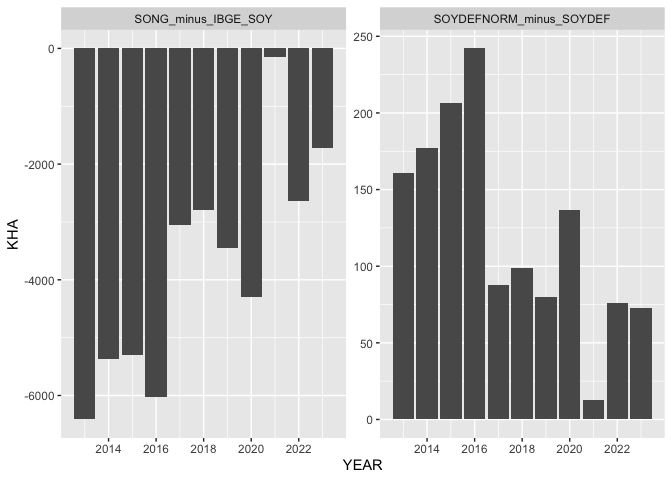
Overall for Brazil, differences between IBGE repported and Song et al’s soy area have been decreasing. However, Soy Deforesattion has been increased throughout all years
At State level (BR-43 is Rio Grande do Sul)
ggplot(BR_state %>% filter(type == "SOYDEFNORM_minus_SOYDEF"), aes(YEAR, KHA)) +
    geom_bar(stat = "identity") +
    labs(title = "SOYDEFNORM_minus_SOYDEF") +
    facet_wrap(~TRASE_ID)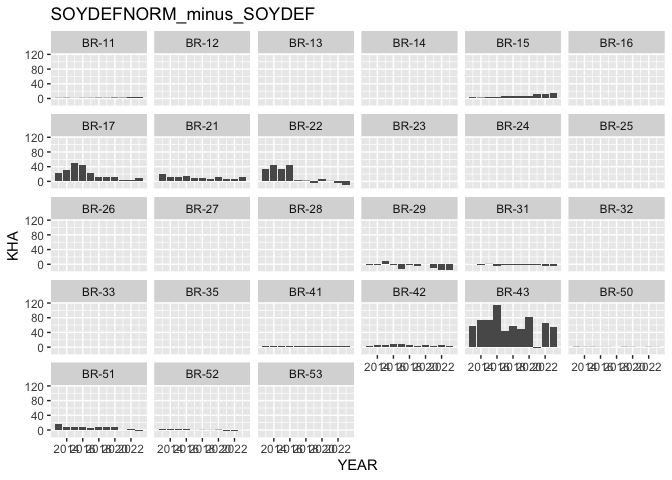
ggplot(BR_state %>% filter(type == "SOYDEFNORM_minus_SOYDEF"), aes(YEAR, KHA)) +
    geom_bar(stat = "identity") +
    labs(title = "SONG_minus_IBGE_SOY") +
    facet_wrap(~TRASE_ID)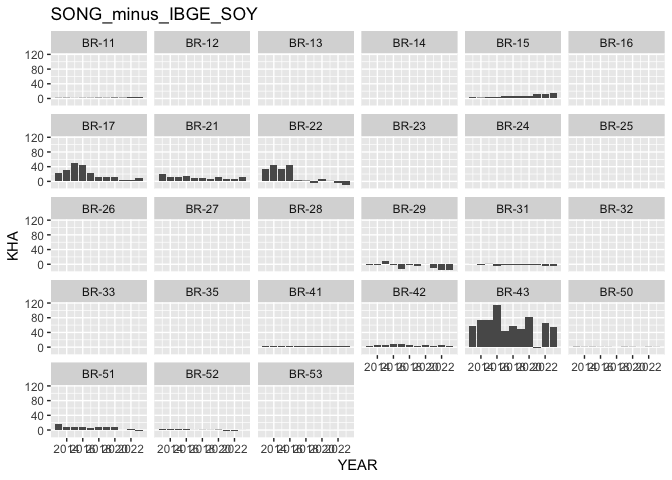
Note that differences are particularly large in Rio Grande do Sul.
Conclusion
Trase commodity deforestation estimates for the Pampas, the source of Cofcos increase in deforestation exposure, has the largest uncertainties attached to its exposure.
Recomendation
next release: reconsider normalization of deforestation and discuss with imapact team (what is the best for communication? I guess as simple as possible ;) ?!)
current communication: Communicate that Pampas deforestation and soy area mapping, even though improving, has among the highest uncertainties attached, which translate to exposure calculation.